


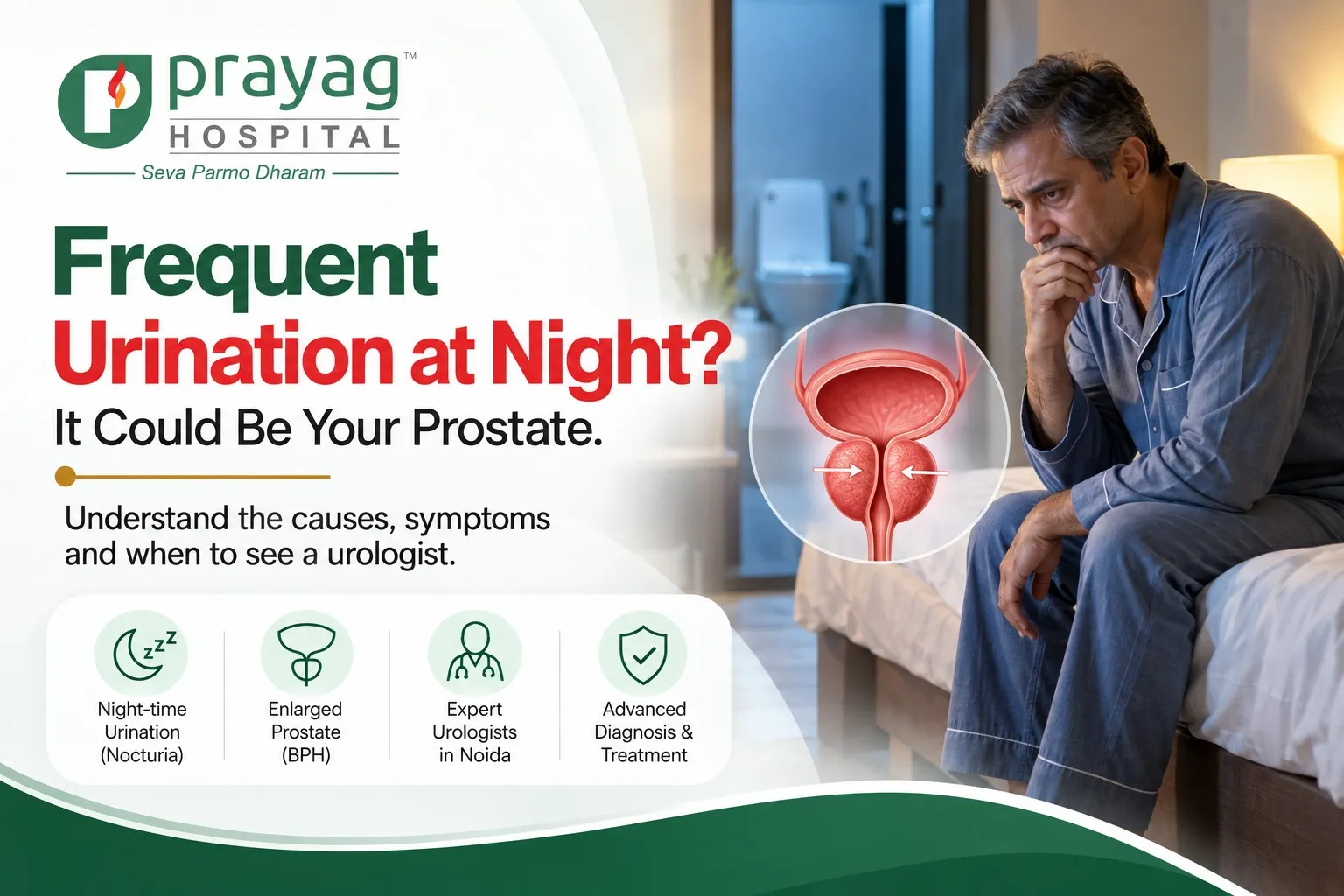
It starts quietly. You wake up once in the night to use the washroom, then twice, then three times. Soon you're tired every morning, planning trips around toilet stops, and telling yourself it's just a natural part of getting older.
Many men live like this for years before speaking to a doctor, often out of hesitation or embarrassment. At Prayag Hospital, Sector 41, Noida, our urologists regularly meet men who say the same thing after treatment: "I didn't realise how much better I could sleep." If you're getting up at night to urinate, here is what could be behind it, and why getting checked makes a lasting difference.
Is Waking Up at Night to Urinate Normal?
Waking up once during the night to urinate can be normal, especially as you age. However, doctors call frequent night-time urination nocturia, and it is definitely worth discussing with a doctor if you regularly wake up twice or more each night to pass urine.
Broken sleep is far from a minor inconvenience. Over time, chronic sleep fragmentation leads to daytime fatigue, brain fog, irritability, decreased productivity, and a significantly higher risk of nighttime falls and fractures, especially in older men.
How the Prostate Can Cause Night-Time Urination
The prostate is a walnut-sized gland that sits directly below the bladder and surrounds the urethra (the tube that carries urine out of the body). In many men, the prostate gradually increases in size as hormone levels change with age. This non-cancerous condition is known as Benign Prostatic Hyperplasia (BPH), or an enlarged prostate.
As the prostate enlarges, it pinches the urethra and exerts pressure on the base of the bladder. Consequently, the bladder muscles must work harder to pump urine and cannot empty completely. Because residual urine remains trapped, the bladder fills back up quickly, triggering frequent urges to urinate throughout the night.
Good to Know: BPH is exceptionally common—over 50% of men in their 60s and up to 90% of men over 70 experience some degree of prostate enlargement. Crucially, BPH is not cancer, and it does not turn into cancer.
Signs of an Enlarged Prostate
Frequent nighttime visits to the bathroom rarely happen alone. Men with BPH frequently notice several of the following lower urinary tract symptoms (LUTS):
Weak or Slow Urine Stream
The flow of urine is noticeably weaker and takes longer to finish.
Hesitancy & Straining
Difficulty starting the stream, or needing to push and strain the abdomen.
Intermittent Flow
A urine stream that starts, stops, and restarts several times.
Terminal Dribbling
Continued dribbling of urine at the end of passing urine.
Incomplete Bladder Emptying
A persistent sensation that your bladder is never completely empty.
Sudden Urinary Urgency
A sudden, intense urge to urinate that is difficult to postpone.
Other Reasons You May Wake Up to Urinate
While an enlarged prostate is the most frequent cause in men over 45, nocturia can also be triggered or exacerbated by several other medical factors:
This is precisely why a comprehensive medical check-up matters: identifying and addressing the exact underlying cause enables targeted care and optimal recovery.
Seek immediate medical attention at our 24x7 Emergency Department if you experience:
- Complete inability to pass urine (Acute Urinary Retention), accompanied by severe lower abdominal pain.
- Visible blood in your urine (Hematuria) or passing dark, rust-colored urine.
- High fever, shaking chills, and sharp burning pain while urinating.
- Severe aching pain in your lower back or side (flank pain) alongside urinary difficulty.
How Is an Enlarged Prostate Diagnosed?
A consultation with a urologist is confidential, straightforward, and completely painless. Based on your symptoms, your specialist may recommend:
Symptom Score (IPSS)
A structured questionnaire to assess symptom severity and impact on quality of life.
Urine Routine & Culture
To check for underlying urinary infections, microscopic blood, or sugar.
PSA & Kidney Blood Tests
Prostate-Specific Antigen (PSA) test, serum creatinine, and blood sugar evaluation.
Ultrasound KUB & PVR
Measures exact prostate volume and post-void residual (PVR) urine left in the bladder.
Uroflowmetry
A quick, non-invasive test measuring urinary flow rate and bladder voiding strength.
Clinical Prostate Exam
A gentle physical examination of the prostate gland, performed only with your consent.
Treatment Options: You Don't Have to Live With It
The great news is that BPH and nocturia are highly treatable conditions. Treatment is customised based on how much the symptoms affect your day-to-day comfort:
Frequently Asked Questions